
Preface
Switch mode power supplies (SMPS) are essential in many industries. They are used in various applications ranging from computers to industrial equipment due to their efficiency and compact design. But like any other electronic device, they can have issues. This blog will focus on the repair of switch mode power supplies and their problems.
What is Switching Power Supply?

A Switching Mode Power Supply (SMPS) is an electronic circuit that converts electrical power using a switching regulator. SMPS are more efficient than traditional linear power supplies and can achieve efficiencies of up to 80% or more depending on the model. The high-frequency switching operation minimizes energy loss and allows the use of smaller transformers and filters, thus making the unit more compact and lightweight. compact and lightweight design makes it possible to use it with a wide range of input voltages, making it suitable for use in varying power conditions.
What are Basic Components of SMPS?
The main components of an SMPS are the control circuit, transformer, power transistors, and other passive elements such as resistors and capacitors. The control circuit controls the switching of the power transistors in order to maintain a constant output voltage when the load or input voltage varies.
High-frequency operations are possible with the use of key components like the ferrite transformer. Filtering and smoothing the output voltage requires electrolytic capacitors. Diodes and transistors are the power components that control the process of conversion. These components are essential in the process of diagnosing faults. For instance, if the power supply fails to start, then it is important to check the primary side components such as the fuse and the control IC.
Understanding the Working Process of SMPS
The working process of an SMPS involves several stages: input rectification, power factor correction, switching and output rectification. First, the AC mains voltage is converted to a DC voltage using a rectifier and a filter and then applied to a high-frequency oscillator circuit. This oscillator is used to drive the switching transistors which convert the DC voltage back into high frequency AC which passes through a transformer. Last is the high-frequency AC which is rectified and filtered to produce a stable DC output. The control circuit ensures that the switching frequency or duty cycle is controlled to ensure that stability is maintained under varying load conditions.
How to Repair Switching Power Supply?

Safety Precautions before Repairing
Before you start repairing any SMPS ensure that you have taken all the safety measures. It is necessary to disconnect the power supply from the mains voltage and discharge any capacitors to avoid electric shock. Make sure that you use an isolation transformer to isolate yourself from the mains voltage during troubleshooting.
Required Tools during Repairing
Some of the tools required for SMPS repair include a multimeter, oscilloscope, ESR meter, variac, and a soldering station. They assist in detecting problems like short circuits, faulty components, and incorrect voltages. An ESR meter is especially useful for assessing the condition of electrolytic capacitors.
Switching Power Supply Troubleshooting
Startup Failures
Blown Fuse
Poor Load Capacity
Overheating
Faulty Control IC
No DC Output or Unstable Voltage Output
High Ripple or Noise
EMI/EMC Issues
Intermittent Operation
Leaky or Bulging Capacitors
Solution: Capacitors that are bulging or leaking should be replaced with new ones of the same capacitance and voltage rating. Test the ESR of other capacitors and replace those with high ESR ratings.
Common Pitfalls to Avoid When Repairing SMPS
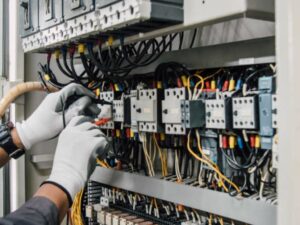
It is important to avoid common mistakes in order to save time and avoid further damage. Do not neglect visual inspections because they will show you obvious problems such as burnt components or bad solder joints. Do not use replacement parts with incorrect specification as this may result in further failures. It is important that you understand the design and operation of the SMPS before repairing.
How to Safely Power On and Test an SMPS After Repairs
Once the repairs are done, it is important to power on the SMPS in a safe manner. Connect a variac to the input and slowly increase the input voltage to observe the output. This helps to avoid sudden breakdowns and enables you to identify any as early as possible. Measure all voltages and waveforms with an oscilloscope to verify that the SMPS operates under load.
Conclusion
Repairing SMPS has to understand the components and the working of the power supply. If you take safety precautions, use the right tools, and know the common problems, you can easily diagnose and repair SMPS faults. It is important to be patient and meticulous when performing repairs.
FAQs
How to improve the efficiency of an older SMPS?
It is possible to increase the efficiency of an older SMPS by replacing old components that are losing their efficiency, for example, electrolytic capacitors with new ones that have lower ESR. It can also help to make sure that all solder joints are properly secured and to replace any outdated or inefficient components with newer ones. Maintenance and visual inspection can also help to identify problems before they lead to efficiency losses.
How to prevent common SMPS failures?
SMPS failures can be avoided by maintenance and proper use. Check that the power supply is within its rated voltage and current. Ensure that there is sufficient cooling and ventilation to avoid overheating. Periodically check and replace old components like electrolytic capacitors that may deteriorate with age. Do not subject the SMPS to extreme conditions like high humidity, dust, and vibration.
How does PWM (Pulse Width Modulation) regulate the output voltage in an SMPS?
SMPS (Switching Mode Power Supply) is controlled by PWM (Pulse Width Modulation) which controls the output voltage by controlling the duty cycle of the switching transistors. The control circuit can control the on-off intervals to keep the output voltage constant even if the input voltage or load changes, thus ensuring the efficiency of the circuit.
How to check the condition of electrolytic caps in an SMPS?


 English
 Spanish
 German
 Russian